
Document Management Trends 2026: Turning AI Pilots into ROI
Document Management Trends 2026: Turning AI Pilots into ROI


Antti Nivala, Founder and Chief Innovation Officer, M-Files
2026 Becomes the Year Pilot Projects Finally Grow Up
After several years of enthusiasm, 2026 will mark a turning point where organizations shift decisively from AI pilots to real, measurable outcomes. Leaders will demand production-ready implementations that deliver tangible ROI, reduce friction in workflows, and improve decision-making. This transition will bring both excitement and disillusionment: some of the hype will meet reality, and not every AI promise will stand up under enterprise scrutiny. But this is also where genuine innovation happens. Companies that recognize the limits of experimentation and invest in operationalizing AI, such as quality data foundations, change management, and scalable processes, will finally start realizing the long-promised productivity gains. 2026 won’t be about novelty; it will be about what actually works.
AI Unlocks the Hidden Value of Unstructured Knowledge
In 2026, AI’s most meaningful impact won’t be in generating new content — it will be in revealing the value of the content organizations already have but haven't been able to use. Decades of research reports, project documentation, customer interactions, and intellectual property have remained difficult to access because humans simply cannot process that volume of information. Generative AI changes that. By enriching context, filling metadata gaps, and synthesizing insights across massive unstructured datasets, AI will allow organizations to tap into “dark knowledge” for the first time. R&D teams will validate new ideas against historical findings in seconds. Strategic decisions will be informed by decades of institutional knowledge. Innovation will increasingly come not from new data, but from finally understanding the data organizations already possess.
Workers Shift from Searchers to Directors of Work
The employee experience will transform fundamentally in 2026. Instead of navigating complex systems, filters, and search queries, workers will operate through intent — telling AI what they need and letting the system handle the mechanics. This shift elevates employees from information hunters to orchestrators of outcomes. Searching will not disappear entirely, but the “how” of search will fade into the background. AI copilots will retrieve the right content, highlight relevant context, and even suggest how information should be applied to the task at hand. Human judgment will remain essential, particularly in verifying accuracy, but the cognitive load of gathering, locating, and preparing information will shrink dramatically. Work becomes less about operating tools and more about directing results.
Compliance Becomes Easier in an AI-Driven Enterprise
Contrary to popular fears, 2026 will demonstrate that AI and compliance are not in conflict. In fact, automation will increasingly serve as compliance’s greatest ally. Manual tasks that once introduced risk, such as classification, versioning, access management, and validation, will be handled more consistently and reliably by AI. Organizations will also learn that the biggest security and compliance failures come from humans, not machines, and that AI can reduce these points of failure when implemented within enterprise-grade guardrails. The critical shift next year will be mindset: instead of searching for AI systems that never make mistakes, organizations will build processes that detect, verify, and mitigate occasional inaccuracies — just as they already do with human work. Trust, but verify, becomes the operating model.
Data Quality Becomes the New Corporate Competitiveness
In 2026, the organizations that benefit most from AI won’t be the ones with the most data — they’ll be the ones with the best-organized, highest-quality data. AI’s ability to deliver value is directly tied to the consistency, structure, and accessibility of the information it’s allowed to use. Companies will increasingly perform “information readiness assessments,” evaluating whether their content is properly governed, contextualized, and available for AI systems. Data quality will shift from an IT initiative to a strategic priority, enabling everything from copilots to analytics to automation. Enterprises that invest early in cleaning and structuring their information ecosystems will pull ahead rapidly, while those that ignore the issue will find their AI initiatives stalling despite significant spend.
Organizations Will Cross the Threshold from Information Management to Knowledge Management
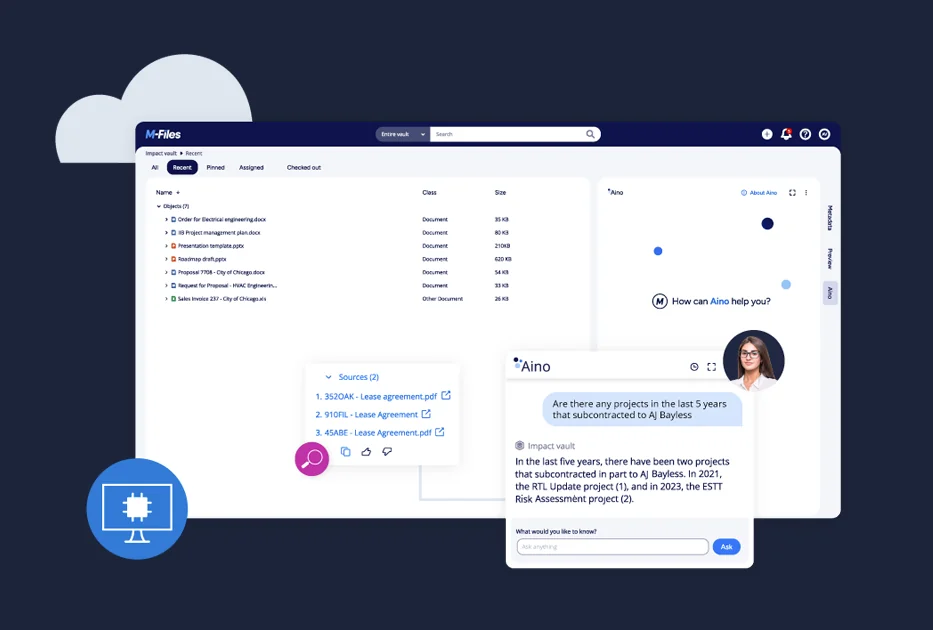
For decades, organizations have talked about knowledge management without ever fully achieving it, as the limitations of technology made it largely aspirational. But in 2026, AI will push us decisively into a new era. Systems will not only store and retrieve documents; they will understand them, contextualize them, and synthesize insights across repositories and formats. Employees will be able to ask questions of their collective organizational knowledge — not just search for files. This transition represents the most profound shift in information work since the move from paper to digital. AI will allow organizations to operate at a scale of knowledge comprehension that humans alone could never reach, transforming how decisions are made, how innovation happens, and how organizations learn.
2026 AI Predictions
When AI Stops Being Impressive and Starts Being Essential
Every major technology shift follows a familiar arc. First comes excitement. Then experimentation. Then disappointment. And finally, impact.
As we look toward 2026, artificial intelligence is entering that final and most important phase. The question is no longer whether AI works. The question is whether organizations are ready to make it work at scale, in reality, and under real world constraints.
From my perspective, 2026 will be remembered as the year AI stopped being a fascinating experiment and became a foundational capability for knowledge work. Not because the technology suddenly improved, but because organizations finally did the hard work required to operationalize it.
Prediction 1. 2026 Becomes the Year Pilot Projects Finally Grow Up
For years, AI pilots have flourished in isolation. Many showed promise. Few delivered lasting value.
In 2026, that era ends.
Leadership teams will no longer tolerate AI initiatives that live outside core business processes. The focus will shift decisively toward production ready implementations that reduce friction, improve decisions, and deliver measurable outcomes. This transition will be uncomfortable for some organizations. Hype will collide with reality. Some investments will not survive closer scrutiny.
But this moment of reckoning is exactly what progress looks like.
Real innovation emerges when organizations accept that AI success is not driven by clever models alone, but by data quality, governance, change management, and scalable operating models. In 2026, the winners will not be those who experimented the most. They will be the ones who embedded AI into the fabric of how work actually gets done.
Prediction 2. AI Unlocks the Hidden Value of Unstructured Knowledge
Much of the AI conversation has focused on its ability to generate content. That narrative misses the deeper shift now underway.
In 2026, AI’s most transformative impact will come from its ability to understand what organizations already know.
Enterprises are sitting on decades of unstructured information, research, contracts, project documentation, customer interactions, and intellectual property. Much of it remains underused not because it lacks value, but because humans cannot process it at scale.
AI changes that. By enriching context, closing metadata gaps, and synthesizing insight across vast information repositories, organizations will finally unlock this hidden knowledge. Innovation will increasingly come not from producing more data, but from making sense of what already exists.
This marks a decisive shift from information accumulation to organizational understanding.
Prediction 3. Workers Shift from Searchers to Directors of Work
The way people interact with information is about to change permanently.
In 2026, knowledge workers will spend far less time searching and far more time directing work through intent. Instead of navigating systems, filters, and complex interfaces, employees will express what they need and allow AI to assemble the relevant context.
This does not eliminate human judgment. It elevates it.
AI copilots will retrieve information, highlight relevance, and suggest next steps. Humans will verify, decide, and act. The cognitive burden of gathering and preparing information shrinks, freeing people to focus on interpretation, strategy, and execution.
Work becomes less about operating tools and more about orchestrating outcomes.
Prediction 4. Compliance Becomes Easier in an AI-Driven Enterprise
There is a persistent fear that AI introduces unacceptable compliance and security risk. In 2026, that fear will largely be disproven.
The reality is simple. Most compliance failures today originate from humans performing manual tasks inconsistently. Classification errors. Version confusion. Misapplied access controls. These are not machine failures. They are process failures.
When implemented within enterprise grade guardrails, AI becomes compliance’s strongest ally. Automation handles repetitive governance tasks with greater consistency and traceability than manual processes ever could. The critical shift is philosophical. Organizations will stop demanding perfection and instead design systems that detect, verify, and mitigate errors, just as they already do with human work.
The operating model becomes pragmatic and resilient. Trust, but verify.
Prediction 5. Data Quality Becomes the New Corporate Competitiveness
By 2026, one truth will be undeniable. AI value scales only as far as information quality allows.
Organizations will discover that having more data does not lead to better outcomes. Having well organized, well governed, and context rich data does. As a result, information readiness will become a board level concern rather than an IT cleanup initiative.
Enterprises will increasingly assess whether their information ecosystems are truly ready for AI, not in theory, but in practice. Those who invest early in structure and governance will accelerate rapidly. Those who do not will see their AI initiatives stall, regardless of how advanced their tools appear.
In the AI era, data quality is not hygiene. It is competitive advantage.
Prediction 6. Organizations Will Cross the Threshold from Information Management to Knowledge Management
For decades, organizations have talked about knowledge management as an aspiration rather than a reality. The technology simply was not capable of delivering on the promise.
In 2026, that changes.
AI enables systems that do more than store and retrieve documents. They understand them. They connect ideas across repositories, time, and context. Employees will no longer search only for files. They will ask questions of their organization’s collective knowledge.
This represents the most significant transformation in information work since the shift from paper to digital. Organizations will operate at a scale of comprehension that was previously impossible, transforming how decisions are made, how innovation happens, and how organizations learn.
What 2026 Ultimately Represents
2026 is not about replacing people with machines. It is about amplifying human capability with context, clarity, and confidence.
The organizations that succeed will be those that stop treating information as a byproduct of work and start treating it as a strategic asset. Those that move beyond experimentation and invest in understanding, not just automation.
This is the year AI grows up. And the organizations that grow with it will define the next era of knowledge work.
Latest Articles



Browse Topics
Resources

Try M-Files Free for 30 Days!
Explore the GenAI capabilities of M-Files Aino, enhance collaboration with colleagues, automate workflows, and unlock endless possibilities.